I've been neglecting this for a long while. For those of you who know what's been going on in my life the last few years, the most succinct explanation is that I've been busy being a homeschool mom and spending more time being an aunt to some amazing adults. That time is something I cherish, but the journey is still on & I am still the mother of an atypical child.
We have now been homsechooling and allowing M to learn at her own pace for over 6 years . . . . officially. Christmas Break was when we started when she was 7 years old and we pulled her out of the middle of 1st grade.
Now, we have a teenager. An amazing teenager who is going through all the normal young teenager challenges and experiences and adjustments that all humans go through in their own way. She has also decided to put off college as long as possible, which has been a relief to our whole family, but definitely her choice. And it's going well. She'll simply have a lot of "extra classes" in a variety of areas and be able to explore more topics to help her decide on a path that makes her happy in her future life.
The last couple of years we have had less obviously atypical situations. There are more and more times where I can go out and have giftedness not be part of the experience. It's been wonderfully peaceful.
There are occasions where someone notices and gets excited and goes off on their own tangent, no even hearing my girl's response . . . recently, a former schoolteacher we ran across doing everyday business . . . .
"You could be the first female president," to which M's eyes got wide and she said, "My friend would be much happier in that role. I don't want my hair to go gray all in one year," lol . . . . The woman didn't even hear her respond and continued along the political options line of suggestions . . . After trying to respond politely to the woman 2-3 times, my girl looked at me and silently sent the message, "Please make her stop talking." Fortunately, a woman we know better was there & stepped in, saving me the trouble and refocusing the conversation on me, telling her what a great mom she thinks I am. This woman has been a super supportive person in my life, obviously. . . .
We run across conversations like that all the time.
Could she go into politics? Her brain could certainly handle the information, but it would make her miserable. It's simply not a good fit for her personality, just like anyone else. The message she gets is that because she can, she should. That's what we're dealing with now.
Fortunately, we have a community of people who are supportive of her leading the way, as she always has. When she was younger, she seemed hungrier and more drawn to speedy progress. Now, she's focusing more on relationships, hobbies, expressing herself with her hairstyle & clothing, etc. M is not superficial, but she is growing up and learning and exploring herself in a different way than she used to. Most of the influential people in her educational life now compliment her maturity in knowing that she doesn't want to rush into a college situation. I love that they are supporting her in this change. It seems respectful, and honoring that they are listening to her & taking it seriously.
And today, the big new thing was getting a slime recipe from her friend and making glitter slime from the new "messy" pikmi pops. If you're not following, just picture the annoying gift filler that's metallic and never goes away no matter how much you vacuum. It comes with these toys & goes everywhere . . . . yay? I digress. The point is that she's still the age she is. Every day is not full of super advanced stuff, but fun stuff that is age appropriate is mixed in regularly, whenever it appeals to her.
In all this, I have gotten comfortable. It's not as constant a project as it was 6 years ago. I am much more comfortable. M also has found more generic answers to people when they ask about educational stuff. We avoid it gently in many situations and now we can get away with it much more often.
Here's the problem with that. There are still many people dealing with the journey in a way closer to ours 6 years ago than now. I want to support them. I also received SO much support and wonderful sounding boards from those with children older than mine. I feel I should pay it forward in whatever way I can. And I want to . . . . most days. Other days, I want to stay comfortably out of it.
I remember thinking that giftedness needed a poster child. That things like ADHD, Autism, Gifted Athleticism, Advanced Artistic ability, and many more areas are celebrated. I still feel like giftedness is seen as pushy parenting and/or conceit. It's a neuroatypicality not unlike some of the things listed in the beginning of this paragraph. It's a need and a want of the child, not the parent. Maybe the parent, as well, but for this parent, not so much. I love my child, so I support her the best way I can, which means dealing with giftedness.
Another person shared similar feelings recently. I don't want anyone to imagine that this blog and my daughter or the facebook information and that child, are templates of giftedness. They are all individuals with different needs and patterns. There are many similarities, tho. As I read this, it took me back and resonated with me. We attended the same coop with this family for a time, although I don't know them really . . . . I am proud of this mother for having the courage and motivation to put it out there. She will be judged and she knows it, but believes it's important enough to do anyway. Hopefully, it will help people think about these often lonely situations and consider the fun parts, as well. Please be cautious about making assumptions. Try to understand and support these families. Like my family . . . .
https://www.facebook.com/ElliottRobbTanner/posts/154453705251857
When people tell me it must be easy, I tell them it's terrifying and wonderful. It's a huge responsibility, and an exhausting position to be in. Consider that Einstein & the Unibomber are both examples of giftedness, and quite different from one another. Ability is one thing. Good outlets for your gifts are quite another. And providing healthy outlets for those abilities and appetites can be daunting. It is also very important. I wonder what amazing things these people will do later in life. Some may be very publicly visible. Some may not. The more love they feel, the more positive their impact is likely to be. . . .
And that applies to people in all special interest groups. Feeling loved and supported is critical and transformative. We try to connect with people in different situsations, believing that genuine interest will lead to unity and strength among people . . . please join us in loving and supporting this variety in people. How boring would it be if we were all the same, anyway?!
Tuesday, April 3, 2018

Thursday, October 26, 2017
Gingko trees - our symbol
Are you familiar with the Gingko tree? It's also known as the Maidenhair, but I grew up hearing it referred to as a Gingko. There was one in my parents' yarn growing up and it always fascinated me.

The leaves are small straight pieces that are attached together & get closer together as they approach the stem, like a fan. As a child, I liked to try & separate every last individual piece on the fallen leaves.
Google identifies it as a food - Gingko Biloba, which I did not connect with it until I was an adult. I always saw it as a dinosaur tree, tho. It is the only living species remaining in Gingkophyta, and has been identified in fossils dating back 270 million years.
https://en.wikipedia.org/wiki/Ginkgo_biloba
So, why on earth do I relate to this tree?
As I mentioned, there was one in the yard as I grew up. It's a very slow-growing tree and was always small compared to more modern & common species. I am physically small. I always have been. M is as well. It is predicted that she will be my size as an adult, but time will tell. So far, she is small according to the growth charts.
I has a smooth trunk, that I used to like to kindof pet as a child. Not smooth & chalky like a birch tree, tho. In the last couple of years, I learned that it produces fruit (duh - it's a food, right?!) that a neighbor told me was the source of the smell of dog droppings every fall, lol . . . . In our current house, we have a Gingko in the yard. An endangered species of tree. That's so cool!
M is the one who first notices the gingko trees now, and I am able to relate some of my childhood memories to her. She seems as fascinated as I am with them, sharing that affinity for the unusual tree.
The gingko I see most often now is not small. I am certain is has been alive much longer than I have because of its size and its slow growth. Unfortunately, I've never felt like our growth has been able to be slow most of the time. I wish it were slower . . . . Sometimes our growth experiences seem to fast and too close together to weather with dignity. We are doing our best.
What does it say about a tree species that it survives over 270 million years, and is the only one that does? It is strong. It is resilient. It has seen it all. The tempoerate seasons, the floods, the draughts, the fires . . . everything. And it's still here. It still grows straight and smooth.
It is the only one like it. Classifying it for a Biology tree project was the easiest example M had. Many times, I feel like I'm alone in the crowd, as does M. We are unique as well. Unique can be amazing. It can also be lonely. Sometimes it is both at the same time.
I'm sure most people have seen the trees that grow near power lines, and the strange shapes the trunks take on as a result, or those that grow after lightning strikes or other trauma. I have never seen a gingko that is not straight and smooth. It doesn't allow itself to be permanently damaged by the changes around it. It remains strong and resilient and has changed less than most species, whether plant or animal, during that time. It may grow slowly, but it is powerful in its own, quiet way.
As an endangered species, you may think that this difference is due to few examples. However, the city of Minneapolis has them on many boulevards, and M noticed the leaves all over St Paul out front of the Ordway theater this week, as well. They are all around this area, quietly carrying on.

My family (within our shared walls) has been through a lot of change and growth. Some of the things have changed us forever, but we are still here and have increased strength & resilience. We try to absorb that which improves us and makes us stronger, just like the sword of Gryffindor in the Harry Potter series.
While I will not claim to be as amazing as the gingko tree, it's still a powerful symbol in our lives and a comforting reminder in our daily lives. I have a challenge for you. As you go through the times you're not sure you can survive, remember the gingko, and keep going. And as you go about your days, see how many you can spot, and notice whether or not they were hidden to you before. As a parallel, what people may you be overlooking in the crowd, just like the gingkos within the forest of trees. . . . .
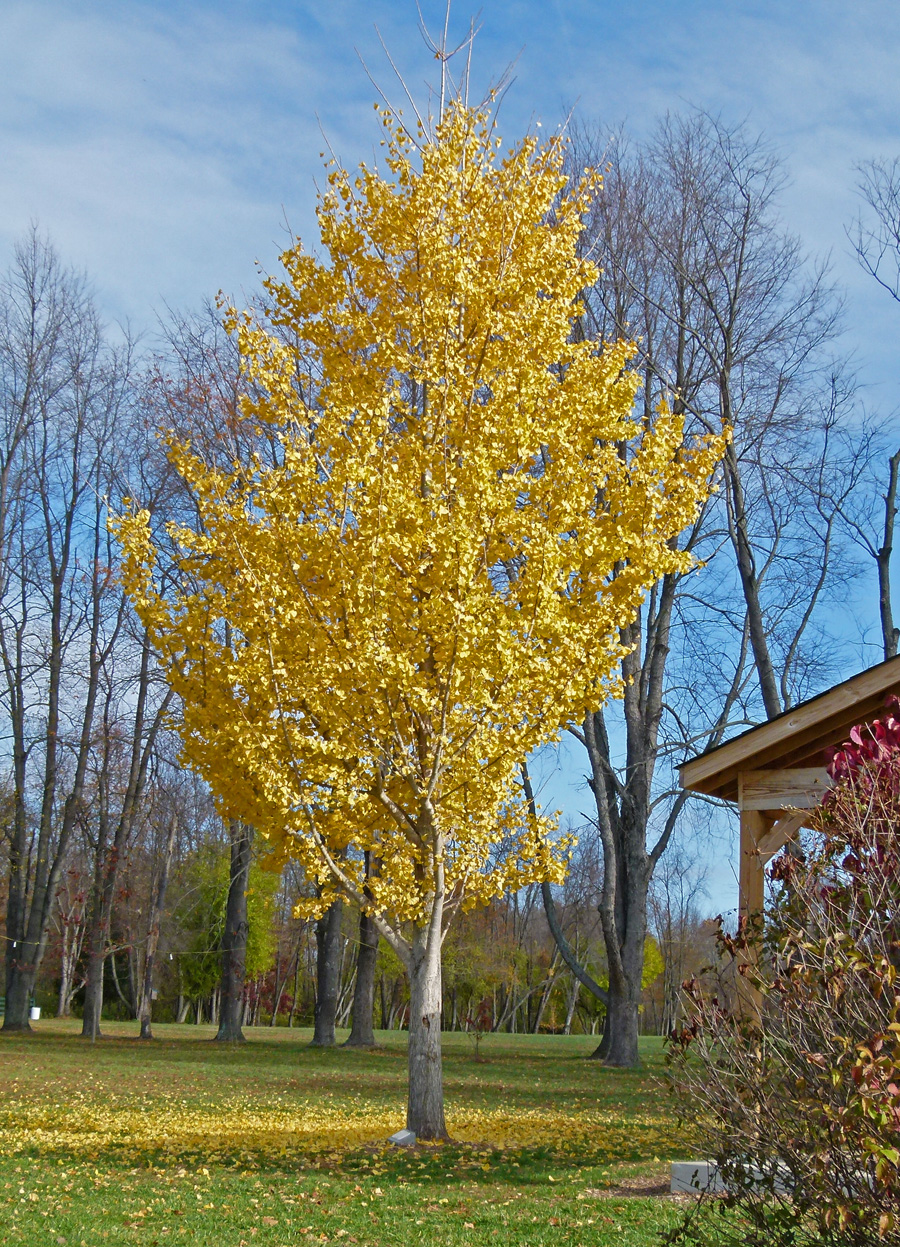
The leaves are small straight pieces that are attached together & get closer together as they approach the stem, like a fan. As a child, I liked to try & separate every last individual piece on the fallen leaves.
Google identifies it as a food - Gingko Biloba, which I did not connect with it until I was an adult. I always saw it as a dinosaur tree, tho. It is the only living species remaining in Gingkophyta, and has been identified in fossils dating back 270 million years.
https://en.wikipedia.org/wiki/Ginkgo_biloba
So, why on earth do I relate to this tree?
As I mentioned, there was one in the yard as I grew up. It's a very slow-growing tree and was always small compared to more modern & common species. I am physically small. I always have been. M is as well. It is predicted that she will be my size as an adult, but time will tell. So far, she is small according to the growth charts.
I has a smooth trunk, that I used to like to kindof pet as a child. Not smooth & chalky like a birch tree, tho. In the last couple of years, I learned that it produces fruit (duh - it's a food, right?!) that a neighbor told me was the source of the smell of dog droppings every fall, lol . . . . In our current house, we have a Gingko in the yard. An endangered species of tree. That's so cool!
M is the one who first notices the gingko trees now, and I am able to relate some of my childhood memories to her. She seems as fascinated as I am with them, sharing that affinity for the unusual tree.
The gingko I see most often now is not small. I am certain is has been alive much longer than I have because of its size and its slow growth. Unfortunately, I've never felt like our growth has been able to be slow most of the time. I wish it were slower . . . . Sometimes our growth experiences seem to fast and too close together to weather with dignity. We are doing our best.
What does it say about a tree species that it survives over 270 million years, and is the only one that does? It is strong. It is resilient. It has seen it all. The tempoerate seasons, the floods, the draughts, the fires . . . everything. And it's still here. It still grows straight and smooth.
It is the only one like it. Classifying it for a Biology tree project was the easiest example M had. Many times, I feel like I'm alone in the crowd, as does M. We are unique as well. Unique can be amazing. It can also be lonely. Sometimes it is both at the same time.
I'm sure most people have seen the trees that grow near power lines, and the strange shapes the trunks take on as a result, or those that grow after lightning strikes or other trauma. I have never seen a gingko that is not straight and smooth. It doesn't allow itself to be permanently damaged by the changes around it. It remains strong and resilient and has changed less than most species, whether plant or animal, during that time. It may grow slowly, but it is powerful in its own, quiet way.
As an endangered species, you may think that this difference is due to few examples. However, the city of Minneapolis has them on many boulevards, and M noticed the leaves all over St Paul out front of the Ordway theater this week, as well. They are all around this area, quietly carrying on.

While I will not claim to be as amazing as the gingko tree, it's still a powerful symbol in our lives and a comforting reminder in our daily lives. I have a challenge for you. As you go through the times you're not sure you can survive, remember the gingko, and keep going. And as you go about your days, see how many you can spot, and notice whether or not they were hidden to you before. As a parallel, what people may you be overlooking in the crowd, just like the gingkos within the forest of trees. . . . .
Monday, April 3, 2017
Annual Testing Time
As a Minnesota Homeschooler, the law requires annual testing. The school district cannot ask for the results of the test, but homeschoolers are required to provide a plan to address cases where the children are below the 30th percentile in any subject.
I think this is interesting & can be related to a family I got to share educational talks with in our last neighborhood. Their daughter struggled in math. She was in public school. She would drop below 60%, so technically failing, and they'd offer her help in math. This help worked, so she was over 60% again, which is technically passing. At that point, her additional help would stop. Before long, she'd drop below 60% and the process would continue like that.
I felt very bad for the girl. It can't be fun to have the emotional roller-coaster and feel the failure and possibly shame of the whole process. I certainly wouldn't enjoy it. She worked hard, too.
This lucky little girl has parents who are very supportive. They had lots of garage sales and paid the hefty fees to have her go to Mathnasium (I think, working from memory) which ended the cycle, but increased the family expense. That brings me back to their many garage sales. The girl is very lucky to have the parents she does.
How is this situation similar to others? I don't know. I imagine she is not alone and that not all parents are willing and/or able to help with an afterschool program. And yet, those afterschool program isn't exactly dance lessons or karate - not the same social value, for sure . . . .
Our own situation is so different. It has different challenges. We are very lucky to be able to homeschool and to have the option to hire tutors and enroll in online and local on-site classes for M. She is thriving, and I love seeing her happiness in the adventure.
Annual testings is kindof like a report card for mom, since I am the homeschool principal. Here's kindof how it goes.
Anticipation:
I freak out that she tested out of Peabody (basicly tested out of HS) last year, when she was 11. I say to myself and my husband and friends my mantra that I will not type here, wanting to keep it G rated.
M asks lots of questions about the new test, which thankfully is given by the same tester she had for her previous few tests, and I don't have answers for her.
Could I research it & answer those? Sure, but I busy wallowing in denial and freaking out, so I don't.
During the test itself:
I sit there feaking out that I'll look like a bad homeschool mom, but also freaking out that she might do better than I can handle or am comfortable with. I both want her to do well and poorly at the same time for various reasons.
I listen & remember her father telling her to "get dumber" a few days earlier. She laughed and lit up - we're weird that way.
I hear her say "I don't know" and immediately follow it with the correct answer.
I hear the tester reassure her when she gets frustrated, reminding her that this test goes through college material.
I remember her years previously telling me she was worried about failing the Peabody & me telling her she'd better fail cause I wasn't ready for her to test out of HS, which made her sit back & think.
I hear her say that her brain is mush and smile, relieved that at least THIS isn't easy for her - she's hard to keep up with & doesn't do well when not challenged, after all.
She chooses to do her weakest subject first, then follow it immediately with her strongest subject, and I realize she has gained the confidence and self-awareness to cope with this far more effectively than previous years.
After the test:
Her father repeatedly asks when we get the results. With Peabody it was immediate. As she progresses, there is processing time. We are still waiting and in the meantime, I'm enjoying the evasive answer of "we're waiting on her annual test results" when people ask me what grade level she's at ;)
People say it must be nice for us. There are many ways that it is. Every child has wonderful qualities and challenging ones. We are lucky to have resources to address our daughter's specific mix. However, not all criminals had a hard time in school. There are many horrific examples of highly gifted kids who grew up to use those talents in very destructive ways. Whatever your situation, struggling in school (like Einstein, for the record, who is universally recognized as brilliant) or bored in school, please remember that all people have different challenges and that every child is a developing person figuring out who they are, what they are passionate about, etc. Love every one of them. They all deserve love. From everyone.
Have a great week!
I think this is interesting & can be related to a family I got to share educational talks with in our last neighborhood. Their daughter struggled in math. She was in public school. She would drop below 60%, so technically failing, and they'd offer her help in math. This help worked, so she was over 60% again, which is technically passing. At that point, her additional help would stop. Before long, she'd drop below 60% and the process would continue like that.
I felt very bad for the girl. It can't be fun to have the emotional roller-coaster and feel the failure and possibly shame of the whole process. I certainly wouldn't enjoy it. She worked hard, too.
This lucky little girl has parents who are very supportive. They had lots of garage sales and paid the hefty fees to have her go to Mathnasium (I think, working from memory) which ended the cycle, but increased the family expense. That brings me back to their many garage sales. The girl is very lucky to have the parents she does.
How is this situation similar to others? I don't know. I imagine she is not alone and that not all parents are willing and/or able to help with an afterschool program. And yet, those afterschool program isn't exactly dance lessons or karate - not the same social value, for sure . . . .
Our own situation is so different. It has different challenges. We are very lucky to be able to homeschool and to have the option to hire tutors and enroll in online and local on-site classes for M. She is thriving, and I love seeing her happiness in the adventure.
Annual testings is kindof like a report card for mom, since I am the homeschool principal. Here's kindof how it goes.
Anticipation:
I freak out that she tested out of Peabody (basicly tested out of HS) last year, when she was 11. I say to myself and my husband and friends my mantra that I will not type here, wanting to keep it G rated.
M asks lots of questions about the new test, which thankfully is given by the same tester she had for her previous few tests, and I don't have answers for her.
Could I research it & answer those? Sure, but I busy wallowing in denial and freaking out, so I don't.
During the test itself:
I sit there feaking out that I'll look like a bad homeschool mom, but also freaking out that she might do better than I can handle or am comfortable with. I both want her to do well and poorly at the same time for various reasons.
I listen & remember her father telling her to "get dumber" a few days earlier. She laughed and lit up - we're weird that way.
I hear her say "I don't know" and immediately follow it with the correct answer.
I hear the tester reassure her when she gets frustrated, reminding her that this test goes through college material.
I remember her years previously telling me she was worried about failing the Peabody & me telling her she'd better fail cause I wasn't ready for her to test out of HS, which made her sit back & think.
I hear her say that her brain is mush and smile, relieved that at least THIS isn't easy for her - she's hard to keep up with & doesn't do well when not challenged, after all.
She chooses to do her weakest subject first, then follow it immediately with her strongest subject, and I realize she has gained the confidence and self-awareness to cope with this far more effectively than previous years.
After the test:
Her father repeatedly asks when we get the results. With Peabody it was immediate. As she progresses, there is processing time. We are still waiting and in the meantime, I'm enjoying the evasive answer of "we're waiting on her annual test results" when people ask me what grade level she's at ;)
People say it must be nice for us. There are many ways that it is. Every child has wonderful qualities and challenging ones. We are lucky to have resources to address our daughter's specific mix. However, not all criminals had a hard time in school. There are many horrific examples of highly gifted kids who grew up to use those talents in very destructive ways. Whatever your situation, struggling in school (like Einstein, for the record, who is universally recognized as brilliant) or bored in school, please remember that all people have different challenges and that every child is a developing person figuring out who they are, what they are passionate about, etc. Love every one of them. They all deserve love. From everyone.
Have a great week!
Sunday, November 13, 2016
Can you please warn her about my situation? A beloved babysitter moves home.
One of my greatest sadnesses about the situation M is growing up in is the impression that she needs to be careful and guarded in everyday interactions. This is not about politeness, and unfortunately, we have gotten burned when we have been open on various occasions.
A young woman we have known since before M was born recently moved back to the city, and she is in college nearby. This is someone M gave Christmas presents to, went to see in school plays and so much more . . . . When she was too young to be interested in sitting still long enough for plays and similar things, she would whenever this lovely lady was involved. Years earlier.
We were ecstatic to have her closer to home again, and M got excited to see her, then immediately hesitant. You see, she has completed about 6-8 grade levels since she last saw this young woman, despite it being a relatively short period of time.
My heart sank when I saw her expression shift. This has nothing to do with the young lady who moved back to town. She has been incredibly accepting and loving of M throughout her life, and has also been one of M's biggest cheerleaders throughout her life. She didn't react negatively to M's atypical situation, but she was unaware of the extent of the differences in our life.
M asked me to "warn" her on behalf of our family before they interacted again. This made me sad. M is incredible and feels no better than anyone else, but her differences make her feels like she shouldn't be proud of the hard work she has done or the things she has passionately sought.
In this country, many people are quick to say they appreciate and encourage diversity.
Let me as you this. In a country where we celebrate diversity and the strength that comes from connecting with a variety of people in our melting pot (politics aside), shouldn't a girl who simply loves learning and learn quickly feel comfortable expressing that? Especially to someone she has loved for years?
What does it say about us that she doesn't? What does it say about us when you realize that she is far from alone in this impression? What does it say that her parents are verbally attacked by strangers for "thinking she/they is/are better than others" when they don't actually think that?
Why does "different than" get interpreted as "better than" or "worse than" in this culture? Are we capable of being neutral in our differences?
What are we missing if we cannot?
I don't have answers, but wanted to ask the questions.
There are a lot of posts about women and girls and celebrating them right now. Why is it that far more girls than boys are uncomfortable admitting to their successes and accomplishments? Can this be addressed? What can you do individually? And let me state the obvious (to me) that I think boys should be comfortable with success, as well as girls.
A different young college woman I know did a great thing when encountering our differences. She knew M in a similar capacity to the one mentioned earlier, but not nearly as well. She said simply, "She should never be ashamed of being smart." And she meant it.
A young woman we have known since before M was born recently moved back to the city, and she is in college nearby. This is someone M gave Christmas presents to, went to see in school plays and so much more . . . . When she was too young to be interested in sitting still long enough for plays and similar things, she would whenever this lovely lady was involved. Years earlier.
We were ecstatic to have her closer to home again, and M got excited to see her, then immediately hesitant. You see, she has completed about 6-8 grade levels since she last saw this young woman, despite it being a relatively short period of time.
My heart sank when I saw her expression shift. This has nothing to do with the young lady who moved back to town. She has been incredibly accepting and loving of M throughout her life, and has also been one of M's biggest cheerleaders throughout her life. She didn't react negatively to M's atypical situation, but she was unaware of the extent of the differences in our life.
M asked me to "warn" her on behalf of our family before they interacted again. This made me sad. M is incredible and feels no better than anyone else, but her differences make her feels like she shouldn't be proud of the hard work she has done or the things she has passionately sought.
In this country, many people are quick to say they appreciate and encourage diversity.
Let me as you this. In a country where we celebrate diversity and the strength that comes from connecting with a variety of people in our melting pot (politics aside), shouldn't a girl who simply loves learning and learn quickly feel comfortable expressing that? Especially to someone she has loved for years?
What does it say about us that she doesn't? What does it say about us when you realize that she is far from alone in this impression? What does it say that her parents are verbally attacked by strangers for "thinking she/they is/are better than others" when they don't actually think that?
Why does "different than" get interpreted as "better than" or "worse than" in this culture? Are we capable of being neutral in our differences?
What are we missing if we cannot?
I don't have answers, but wanted to ask the questions.
There are a lot of posts about women and girls and celebrating them right now. Why is it that far more girls than boys are uncomfortable admitting to their successes and accomplishments? Can this be addressed? What can you do individually? And let me state the obvious (to me) that I think boys should be comfortable with success, as well as girls.
A different young college woman I know did a great thing when encountering our differences. She knew M in a similar capacity to the one mentioned earlier, but not nearly as well. She said simply, "She should never be ashamed of being smart." And she meant it.
Monday, August 29, 2016
Giftedness and Carpooling - Mixed reactions
As I'm arranging carpooling for some Fall activities, this topic is on my mind, and has me giggling with amusement.
M doesn't like carpooling. I'm glad she has told me, but we will still be carpooling.
Let's face it. Interacting with other individuals can be irritating and complicated. That's part of the reality of being human. None of us are immune.
I know a lovely woman who is one of the most warm, tolerant people I have ever met. She will not get in the car without her son having 2 books, "because what if he finishes one?!"
When I heard this, I laughed really hard and felt very relieved to not be alone.
M likes quiet in the car, which is ironic. She never stops talking. Not just in the car, either.
When we have to drive in the morning, I am grumpy. I know I am not alone in this. Grumpiness is most common in the morning, second only maybe to driving in traffic. I'm guessing - this is not a scientific statement. It rings true, though, doesn't it?
We did some carpooling to 4H events this summer, and there were siblings riding with us. Siblings fight. It's part of being a sibling. M is an only child. She's adapting, but sibling fighting still upsets her sometimes. Siblings fight in the car, too.
In one instance, the siblings were being particularly irritable with each other. I had another I'm-Not-Alone moment when the mother, also riding with us, suggested putting an audio book on for them.
As Fall approaches, we will be in the car a lot more. More of our in-person activities are during the school year, and some of them are quite a distance. They are worth it, but the car time is still something I plan ahead for and get stressed about.
My solution this year was to stock up on audio books from the library and try some different ones, so we'll have something to look forward to in the car. I keep 2 in there, too, just in case we finish one, lol.
One activity we are new to carpooling, since we moved this calendar year. I am grateful to have a carpool. The decreased driving, reduced emissions, reduced gas cost, etc. are wonderful! M believes in all those things, too. She still seems wary however.
"Just as long as it's a quiet carpool," was her initial response. Pause for internal hysterical laughter on my part! I told her that we didn't know, and that it was going to happen either way.
Then, I talked to my husband. He suggested having coffee with the other drivers before the start so we could give them a heads up and M would not be grilled with questions.
While I understand his concern, this may not happen. It simply may not be possible. Besides, M is who she is and will have to learn to react to a variety of responses to her unique situation.
I did, however, have to disclose that she cannot ride in the front of the car. This is not something I anticipated being part of the atypicality of our lives. The place she's going, at that time, does not offer classes for her age. So, I had to let them know that she is small and young as a logistical concern.
Will I ever get used to this? Every time I think I'm close, I get surprised again.
I don't know how this is going to work, but I am grateful to have a carpool arranged, and to have M experiencing this part of life that is so much a part of so many lives in this area.
I am also grateful to have her around people who are not part of her "special population." I think in an effort to feel included, we sometimes insulate ourselves too much. This can lead to thinking about people as "us" and "them" even when that is not our intention.
My husband and I intentionally put ourselves out there. We want people to feel loved and appreciated and respected. That sometimes means that people who consider themselves part of a description that we ascribe to, disagree with our decisions. In extreme cases, we are rejected for attempting to be inclusive.
I will continue to try and be inclusive. For carpooling, I simply disclosed that she is small and young, but a HS student, adding only that it's a long story. This was acknowledged in a way that seems positive and encouraging. I responded yet again in a way that downplayed the differences, saying that it's like anything else - it has pros and cons.
I'm not going to apologize or explain myself or M to everyone. M is a HS student. Yes, she is small, because she takes after her mother. Yes, she is young. That's simply when she was born. If people assume we are snobs, then that's their impression. We cannot control their heads.
We can control ourselves. We can show interest in other people's interests, and appreciate all sorts of things in all sorts of people. We choose to focus on loving people. Hopefully, by accepting ourselves and loving ourselves and our differences, we can encourage other people to accept and love differences in themselves and others. That is also M's goal. I am so proud of her for that.
Isn't it amazing what arranging a carpool can bring up? I wonder what it would be like to have a simple life . . . Does anyone really have that?
M doesn't like carpooling. I'm glad she has told me, but we will still be carpooling.
Let's face it. Interacting with other individuals can be irritating and complicated. That's part of the reality of being human. None of us are immune.
I know a lovely woman who is one of the most warm, tolerant people I have ever met. She will not get in the car without her son having 2 books, "because what if he finishes one?!"
When I heard this, I laughed really hard and felt very relieved to not be alone.
M likes quiet in the car, which is ironic. She never stops talking. Not just in the car, either.
When we have to drive in the morning, I am grumpy. I know I am not alone in this. Grumpiness is most common in the morning, second only maybe to driving in traffic. I'm guessing - this is not a scientific statement. It rings true, though, doesn't it?
We did some carpooling to 4H events this summer, and there were siblings riding with us. Siblings fight. It's part of being a sibling. M is an only child. She's adapting, but sibling fighting still upsets her sometimes. Siblings fight in the car, too.
In one instance, the siblings were being particularly irritable with each other. I had another I'm-Not-Alone moment when the mother, also riding with us, suggested putting an audio book on for them.
As Fall approaches, we will be in the car a lot more. More of our in-person activities are during the school year, and some of them are quite a distance. They are worth it, but the car time is still something I plan ahead for and get stressed about.
My solution this year was to stock up on audio books from the library and try some different ones, so we'll have something to look forward to in the car. I keep 2 in there, too, just in case we finish one, lol.
One activity we are new to carpooling, since we moved this calendar year. I am grateful to have a carpool. The decreased driving, reduced emissions, reduced gas cost, etc. are wonderful! M believes in all those things, too. She still seems wary however.
"Just as long as it's a quiet carpool," was her initial response. Pause for internal hysterical laughter on my part! I told her that we didn't know, and that it was going to happen either way.
Then, I talked to my husband. He suggested having coffee with the other drivers before the start so we could give them a heads up and M would not be grilled with questions.
While I understand his concern, this may not happen. It simply may not be possible. Besides, M is who she is and will have to learn to react to a variety of responses to her unique situation.
I did, however, have to disclose that she cannot ride in the front of the car. This is not something I anticipated being part of the atypicality of our lives. The place she's going, at that time, does not offer classes for her age. So, I had to let them know that she is small and young as a logistical concern.
Will I ever get used to this? Every time I think I'm close, I get surprised again.
I don't know how this is going to work, but I am grateful to have a carpool arranged, and to have M experiencing this part of life that is so much a part of so many lives in this area.
I am also grateful to have her around people who are not part of her "special population." I think in an effort to feel included, we sometimes insulate ourselves too much. This can lead to thinking about people as "us" and "them" even when that is not our intention.
My husband and I intentionally put ourselves out there. We want people to feel loved and appreciated and respected. That sometimes means that people who consider themselves part of a description that we ascribe to, disagree with our decisions. In extreme cases, we are rejected for attempting to be inclusive.
I will continue to try and be inclusive. For carpooling, I simply disclosed that she is small and young, but a HS student, adding only that it's a long story. This was acknowledged in a way that seems positive and encouraging. I responded yet again in a way that downplayed the differences, saying that it's like anything else - it has pros and cons.
I'm not going to apologize or explain myself or M to everyone. M is a HS student. Yes, she is small, because she takes after her mother. Yes, she is young. That's simply when she was born. If people assume we are snobs, then that's their impression. We cannot control their heads.
We can control ourselves. We can show interest in other people's interests, and appreciate all sorts of things in all sorts of people. We choose to focus on loving people. Hopefully, by accepting ourselves and loving ourselves and our differences, we can encourage other people to accept and love differences in themselves and others. That is also M's goal. I am so proud of her for that.
Isn't it amazing what arranging a carpool can bring up? I wonder what it would be like to have a simple life . . . Does anyone really have that?
Wednesday, August 24, 2016
Age really doesn't matter - play habits of the highly gifted
I was struck by this concept yet again during National Night Out. We met some more neighbors, including several very close to M's age. She played with some. Some were interested in a pet we brought out with us. However, there was one really cool connection.
I'm going to back up a bit. M, along with many highly gifted children, was most often drawn to adults as a child. Playing with other kids was fine, but she was just as often found striking up conversations with adults.
When you think about it, this makes sense. Her intellect was so much more advanced than we were aware, and she was filling a hunger for advanced verbal interaction by targeting adults instead of other preschoolers, etc. Many experts (and complete novices) will express extreme concern over this behavior and it can be mislabelled.
M has outgrown this to a large extent. She still is comfortable talking with adults and enjoys that interaction. She also enjoys interaction with some people her own age, as well as some of just about every age.
I have a theory that she somewhat skipped part of her childhood. When other kids were engrossed in their toys, she could never get very excited about them. She wanted to, and you could see it in her eyes and behavior, but the fun of toys for her was very mild, and sometimes completely absent.
At that time, she was obsessed with animals, weather, and a few other scientific ideas. Mostly, she wanted to consume documentaries and nonfiction books on those subjects. I was sad to think she might be missing out on some of her childhood.
Back to National Night Out. A girl who had been noticing M outside sought her out and asked her to play. This adorable delight is 6-7 years younger than M, which momentarily concerned M, but she said "sure," and they quickly showed how similar they were. I wonder what the kids closer to M's own age thought . .. . it doesn't really matter, but it was very interesting for me to see.
Since then, we have found that we connect very well with the parents of this girl, as well. We seem to be wired the same way. Four females had a good time doing things that wouldn't have been very interesting in other company, but was very fun in this instance. And, since M has taken the Red Cross Babysitters course, she has had the opportunity to babysit her new friend, to the satisfaction of everyone involved.
In our usual group of friends, none of them are the same age as M. One is close in age, but some are only slightly older than the neighbor girl. I find it interesting to see how M interacts with them. Things she wouldn't be interested in playing with on her own, she will get out and excited, creatively play with her friends of all ages. I like to think that she is recapturing some of what she may have missed while she was too busy reading to play with toys.
If you step back a bit and think of your own friends, this makes sense. In school, kids are arranged based on a 12 month period of time of birth. I suppose it's as good a way to divide them as any, but it doesn't always work well. As an adult, how many of your friends were born in that same 12 month period of time? Very few of mine were.
Another evidence of how much this gets ingrained into us is that our kids get steered to play with kids close to their own age. In one family, at least recently, M is more drawn to the girl who is farther from her age, and it seems this girl is more drawn to M than her older sister. Since the adults were in those neat little groups, it seems like we assumed the similar ages would be the closer connection. This is an assumption I am trying to remove from my own outlook.
When we, as adults and parents, interact with other adults, I find another phenomenon that parallels this. Most people we meet assume that we are the same age as them so long as they can relate to our life stage. For example, if someone has college-aged kids, they may assume they are older than we are, since M is younger.
Interestingly, people have children at vastly different ages and this is considered completely socially acceptable, yet we make this assumption . . . I wonder if this is the lingering effect of school grouping.
It goes a step further. Most people assume that my husband and I are the same age. While there isn't a huge age gap, there is a significant one. Unless something triggers the information, such as a reference to older TV shows or music, people assume that we are the same age.
The encouraging thing about all of this is that people who you get along with tend to assume similarity and connection. I find this incredibly comforting during a time of dissension in various groups in our country.
I do not write this with an agenda, moral, or lesson, but simply muse about an experience that I am witnessing and comparing it to other experiences in my own life.
As Dr Deb Ruf said, "you hang out with people who get your jokes." May you have many wonderfully connected people in your life of all ages, and encourage those satisfying relationships in the lives of those around you. Always.
I'm going to back up a bit. M, along with many highly gifted children, was most often drawn to adults as a child. Playing with other kids was fine, but she was just as often found striking up conversations with adults.
When you think about it, this makes sense. Her intellect was so much more advanced than we were aware, and she was filling a hunger for advanced verbal interaction by targeting adults instead of other preschoolers, etc. Many experts (and complete novices) will express extreme concern over this behavior and it can be mislabelled.
M has outgrown this to a large extent. She still is comfortable talking with adults and enjoys that interaction. She also enjoys interaction with some people her own age, as well as some of just about every age.
I have a theory that she somewhat skipped part of her childhood. When other kids were engrossed in their toys, she could never get very excited about them. She wanted to, and you could see it in her eyes and behavior, but the fun of toys for her was very mild, and sometimes completely absent.
At that time, she was obsessed with animals, weather, and a few other scientific ideas. Mostly, she wanted to consume documentaries and nonfiction books on those subjects. I was sad to think she might be missing out on some of her childhood.
Back to National Night Out. A girl who had been noticing M outside sought her out and asked her to play. This adorable delight is 6-7 years younger than M, which momentarily concerned M, but she said "sure," and they quickly showed how similar they were. I wonder what the kids closer to M's own age thought . .. . it doesn't really matter, but it was very interesting for me to see.
Since then, we have found that we connect very well with the parents of this girl, as well. We seem to be wired the same way. Four females had a good time doing things that wouldn't have been very interesting in other company, but was very fun in this instance. And, since M has taken the Red Cross Babysitters course, she has had the opportunity to babysit her new friend, to the satisfaction of everyone involved.
In our usual group of friends, none of them are the same age as M. One is close in age, but some are only slightly older than the neighbor girl. I find it interesting to see how M interacts with them. Things she wouldn't be interested in playing with on her own, she will get out and excited, creatively play with her friends of all ages. I like to think that she is recapturing some of what she may have missed while she was too busy reading to play with toys.
If you step back a bit and think of your own friends, this makes sense. In school, kids are arranged based on a 12 month period of time of birth. I suppose it's as good a way to divide them as any, but it doesn't always work well. As an adult, how many of your friends were born in that same 12 month period of time? Very few of mine were.
Another evidence of how much this gets ingrained into us is that our kids get steered to play with kids close to their own age. In one family, at least recently, M is more drawn to the girl who is farther from her age, and it seems this girl is more drawn to M than her older sister. Since the adults were in those neat little groups, it seems like we assumed the similar ages would be the closer connection. This is an assumption I am trying to remove from my own outlook.
When we, as adults and parents, interact with other adults, I find another phenomenon that parallels this. Most people we meet assume that we are the same age as them so long as they can relate to our life stage. For example, if someone has college-aged kids, they may assume they are older than we are, since M is younger.
Interestingly, people have children at vastly different ages and this is considered completely socially acceptable, yet we make this assumption . . . I wonder if this is the lingering effect of school grouping.
It goes a step further. Most people assume that my husband and I are the same age. While there isn't a huge age gap, there is a significant one. Unless something triggers the information, such as a reference to older TV shows or music, people assume that we are the same age.
The encouraging thing about all of this is that people who you get along with tend to assume similarity and connection. I find this incredibly comforting during a time of dissension in various groups in our country.
I do not write this with an agenda, moral, or lesson, but simply muse about an experience that I am witnessing and comparing it to other experiences in my own life.
As Dr Deb Ruf said, "you hang out with people who get your jokes." May you have many wonderfully connected people in your life of all ages, and encourage those satisfying relationships in the lives of those around you. Always.
Friday, August 5, 2016
Autism and giftedness - a mother's reflections
I will start out by saying that I am not an expert, doctor, or any other kind of authority on the topic of autism. My experiences are those of the parent of a high gifted girl and the ways that intersects with the topic of autism. By no means do I claim to be perfect or speaking to every situation.
The topic of autism and giftedness came up in a conversation with friends who also have highly gifted children last night, and I've been pondering it ever since. To my knowledge, non of their children have autism.
"I've worked with autistic kids before, so I have a lot of knowledge about how to interact with her."
This was in an e-mail from a teacher working with my girl. I never said she had autism. In fact, she isn't, and she's been tested. She is very literal, extremely conerned about rules, highly anxious, and asynchronous in her development. I was annoyed that the teacher assumed to be so knowledgeable, but I was not angry. Other people got angry.
When I mentioned this to our friends last night, there was silence, which is EXTREMELY odd when those three families are in the same building. The expressions were those of stunned, confused and incredulous adults. Then another dad said that made no sense, shaking his head as if to dislodge a fly.
"Is she . . . . . on the spectrum?" was another teachers response to me - it was a drama teacher.
At least this woman was cautious, uncomfortable and honestly asking, rather than the conceited assumption that she was correct in her wondering. I said no, but acknowledged that she has some symptoms that might seem like it. She apologized and was genuinely interested in engaging my child in her class. As the dad last night would quickly point out, M has other habits and personality traits that are completely against the idea of autism. However, when she feels unsafe about acceptance, etc, she gets quiet, so those are less obvious at those times.
In that case, I had insisted that M take a drama class. I feel that learning to perform in front of people, to control expressions and actions to an end, and to control yourself under pressure are life skills. Since M is not interested in performance related activities, I do require this from time to time in order to make sure she's getting the experiences I feel are necessary, as her mother and her homeschooling principal. She hated it. It was only a few weeks, however, and she accepted that I don't require her to do many things she genuinely dislikes that much, so she was compliant.
A girl who was very loving toward her was also in this class. That girl is an incredibly gifted actress, and has gotten interest and audition invitations from Disney. Their interest levels are VERY different. In an attempt to cheer M up and simply be friends with her, she had put her arm around M's shoulder and encouarged her into the classroom, standing beside her and just trying to be friends as tween girls do.
Unfortunately, the act of an arm around the shoulder does not feel friendly to her, especially when it is speeding her progress toward something she doesn't like. Her response to those situations is to shut down and almost freeze. This is basicly what she did in that class.
Isn't it interesting how this came across to the teacher? I'm an analytical person, so I can sometimes separate myself from the emotion of it.
The discussion last night was about a child I have never met, who has recently been diagnosed with autism. The school noticed that he plays alongside other kids rather than with them, most of the time. That is the basis of the discussion from last night.
He was diagnosed because of playing alongside rather than with other kids at school. His mother and I have a mutual friend, so I heard about it. Guess what happened when her kids visited with him? There was no alongside. This precious child was engaged for hours and hours playing with the other kids. Those kids are highly gifted. They are asynchronous, so parts of their play may look young & parts may seem detailed to the extreme. They are wired differently. They are not better than anyone else. They are not worse than anyone else. They are simply different.
Play is supposed to be fun. If it is not, it's not effective play. Why should we assume there is a right way to have fun that fits every child? There isn't for adults . . . .
M played alongside other kids for a VERY long time. Part of it is that highly gifted kids play so differently.
I remember the first day that one of our friends brought her kids to the coop that is the first place we felt at home. The mom went outside with kids who were going to play predator and prey. As soon as she saw it, she decided it exemplified giftedness in play. Instead of just using predator and prey as the categories, they gave examples of animals that they were playing, then another kid would announce they were an animal that would prey upon it. Yet another kid would say they were a type of prey that is actually poisonous to the predator in question. I cannot give you the specific examples they used that day because they honestly know a lot more about animals than I do. Those kids used the specific names and types in their play.
When is the last time you heard about that at recess at a school? Might that be why they play alongside? If they like playing that way, might they get bored if they were forced to simplify all the time? Might they get ostracized for being themselves in a school environment?
In our society, which expresses so much concern for individuality being respected, gifted kids are not being shown the same level of passionate support. They are being labelled as someone with an ailment to be treated. I don't understand why. Do we think that people really only are different from each other once they turn 18? Do we believe that people only deserve respect once they are legally adults?
The legislation about special education in the 90s included giftedness when it didn't get passed. Giftedness was removed from the accomodations, and then it passed. Does that upset anyone else? Are those people less important?
The topic of autism and giftedness came up in a conversation with friends who also have highly gifted children last night, and I've been pondering it ever since. To my knowledge, non of their children have autism.
"I've worked with autistic kids before, so I have a lot of knowledge about how to interact with her."
This was in an e-mail from a teacher working with my girl. I never said she had autism. In fact, she isn't, and she's been tested. She is very literal, extremely conerned about rules, highly anxious, and asynchronous in her development. I was annoyed that the teacher assumed to be so knowledgeable, but I was not angry. Other people got angry.
When I mentioned this to our friends last night, there was silence, which is EXTREMELY odd when those three families are in the same building. The expressions were those of stunned, confused and incredulous adults. Then another dad said that made no sense, shaking his head as if to dislodge a fly.
"Is she . . . . . on the spectrum?" was another teachers response to me - it was a drama teacher.
At least this woman was cautious, uncomfortable and honestly asking, rather than the conceited assumption that she was correct in her wondering. I said no, but acknowledged that she has some symptoms that might seem like it. She apologized and was genuinely interested in engaging my child in her class. As the dad last night would quickly point out, M has other habits and personality traits that are completely against the idea of autism. However, when she feels unsafe about acceptance, etc, she gets quiet, so those are less obvious at those times.
In that case, I had insisted that M take a drama class. I feel that learning to perform in front of people, to control expressions and actions to an end, and to control yourself under pressure are life skills. Since M is not interested in performance related activities, I do require this from time to time in order to make sure she's getting the experiences I feel are necessary, as her mother and her homeschooling principal. She hated it. It was only a few weeks, however, and she accepted that I don't require her to do many things she genuinely dislikes that much, so she was compliant.
A girl who was very loving toward her was also in this class. That girl is an incredibly gifted actress, and has gotten interest and audition invitations from Disney. Their interest levels are VERY different. In an attempt to cheer M up and simply be friends with her, she had put her arm around M's shoulder and encouarged her into the classroom, standing beside her and just trying to be friends as tween girls do.
Unfortunately, the act of an arm around the shoulder does not feel friendly to her, especially when it is speeding her progress toward something she doesn't like. Her response to those situations is to shut down and almost freeze. This is basicly what she did in that class.
Isn't it interesting how this came across to the teacher? I'm an analytical person, so I can sometimes separate myself from the emotion of it.
The discussion last night was about a child I have never met, who has recently been diagnosed with autism. The school noticed that he plays alongside other kids rather than with them, most of the time. That is the basis of the discussion from last night.
He was diagnosed because of playing alongside rather than with other kids at school. His mother and I have a mutual friend, so I heard about it. Guess what happened when her kids visited with him? There was no alongside. This precious child was engaged for hours and hours playing with the other kids. Those kids are highly gifted. They are asynchronous, so parts of their play may look young & parts may seem detailed to the extreme. They are wired differently. They are not better than anyone else. They are not worse than anyone else. They are simply different.
Play is supposed to be fun. If it is not, it's not effective play. Why should we assume there is a right way to have fun that fits every child? There isn't for adults . . . .
M played alongside other kids for a VERY long time. Part of it is that highly gifted kids play so differently.
I remember the first day that one of our friends brought her kids to the coop that is the first place we felt at home. The mom went outside with kids who were going to play predator and prey. As soon as she saw it, she decided it exemplified giftedness in play. Instead of just using predator and prey as the categories, they gave examples of animals that they were playing, then another kid would announce they were an animal that would prey upon it. Yet another kid would say they were a type of prey that is actually poisonous to the predator in question. I cannot give you the specific examples they used that day because they honestly know a lot more about animals than I do. Those kids used the specific names and types in their play.
When is the last time you heard about that at recess at a school? Might that be why they play alongside? If they like playing that way, might they get bored if they were forced to simplify all the time? Might they get ostracized for being themselves in a school environment?
In our society, which expresses so much concern for individuality being respected, gifted kids are not being shown the same level of passionate support. They are being labelled as someone with an ailment to be treated. I don't understand why. Do we think that people really only are different from each other once they turn 18? Do we believe that people only deserve respect once they are legally adults?
The legislation about special education in the 90s included giftedness when it didn't get passed. Giftedness was removed from the accomodations, and then it passed. Does that upset anyone else? Are those people less important?
Subscribe to:
Posts (Atom)